
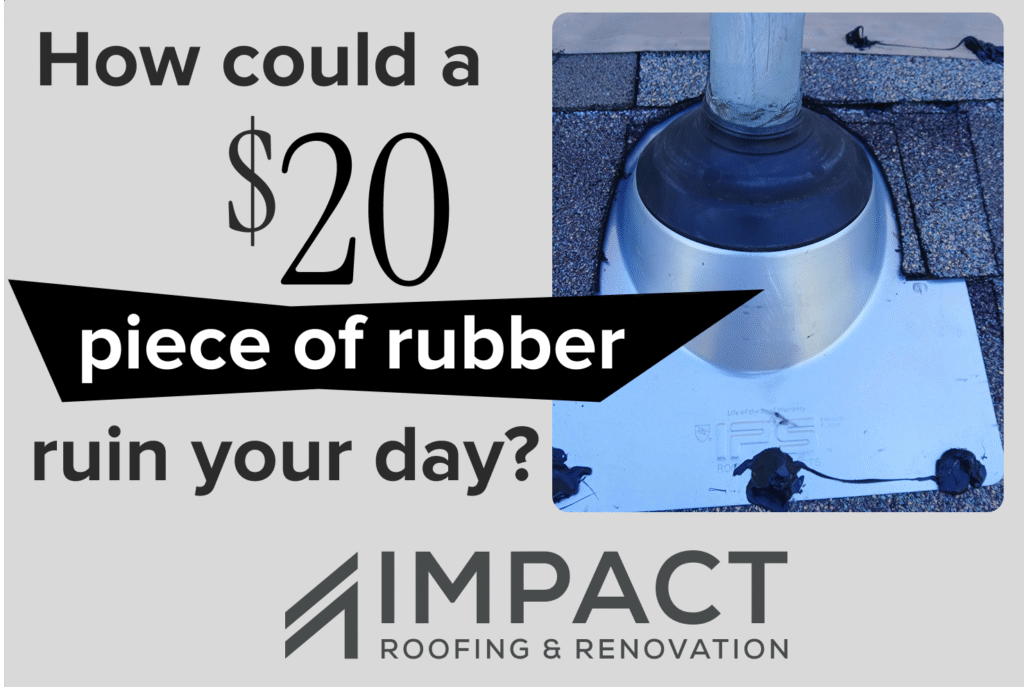
Is a $20 piece of rubber plotting to destroy your living room?
Let’s be real for a second. When you lie awake at night worrying about your roof (okay, maybe you don’t do that, but we do), you’re usually picturing a baseball-sized hailstone smashing through your shingles. That’s the classic “Austin Roof Nightmare,” right?
But here in Central Texas, the real enemy isn’t always falling from the sky in the form of ice. Sometimes, the enemy is just sitting there, day after day, baking in the relentless sun.
While everyone is looking for hail divots, there is a tiny, unassuming component on your roof that is likely failing right now. It’s not the shingles. It’s the plumbing vent boot. And if you ignore it, it can cause thousands of dollars in interior damage before your roof is even halfway through its lifespan.
Meet the Pipe Boot: The Unsung Hero (and Villain)
If you go outside and look up at your roof, you’ll see several PVC pipes poking out. These are your plumbing vents. They allow air to enter your plumbing system so water can flow smoothly to the sewer (and so your house doesn’t smell like… well, you know).
Because your roof is cut open to let these pipes through, you’ll see a gap between the round pipe and the flat roof deck. To seal that gap, roofers install a flashing component called a “pipe boot.”
Traditionally, this boot is a square piece of metal with a rubber collar in the center. The metal slides under the shingles, and the rubber collar fits snugly around the PVC pipe to stop water from sliding down into your attic.
When it’s new, it’s a perfect system. The rubber is flexible, tight, and waterproof. But then, Texas happens.
The Problem: Blazing Texas Sun
Asphalt shingles are incredibly tough. They are designed with ceramic granules to reflect UV rays and modified asphalt to handle thermal cycling. A good architectural shingle can handle 20 to 30 years of Austin heat.
The rubber on a standard pipe boot? Not so much.
Think about an old rubber band you left on a windowsill for a summer. What happens to it? It gets brittle. It cracks. If you touch it, it snaps.
That is exactly what is happening to your pipe boots. After about 7 to 10 years of enduring 100°F+ summers (where rooftop temperatures can exceed 150°F), that rubber collar gets crispier than burnt bacon.
And when a roofer installs the boot, they may forget to seal up any exposed nails…here’s a way to shorten the time to failure even faster!
The Stages of Failure:
- Hardening: The plasticizers in the rubber evaporate. The collar loses its flexibility.
- Split: As the PVC pipe expands and contracts with temperature changes, the now-brittle rubber can’t stretch, so it splits.
- Separation: Eventually, the rubber collar might separate entirely from the pipe, leaving a wide-open gap for water to enter.
The “Invisible” Leak When Pipe Boots Fail
Here is the kicker: You won’t know this has happened until it’s too late.
When a pipe boot fails, water runs down the outside of the pipe. It usually travels through the attic insulation (which soaks up the water like a sponge) and eventually hits the drywall ceiling in a bathroom, kitchen, or laundry room.
You end up with a brown, ugly water stain on your ceiling during a gentle Tuesday rain shower. You scratch your head thinking, “There wasn’t a storm. Why is my roof leaking?”
It’s not a storm damage issue; it’s a maintenance issue. And unfortunately, insurance rarely covers leaks caused by “wear and tear” or lack of maintenance.
The Fix: A Roof Tune-Up
Here is the good news, and we want you to hear this loud and clear: You probably do not need a new roof.
Homeowners are often terrified to call a roofer for a small leak because they fear the sales pitch for a $20,000 replacement. At Impact Roofing + Renovations, that’s not our style.
If your shingles are in good shape, we can simply perform a “Roof Tune-Up.”
- Remove: We carefully lift the surrounding shingles and remove the old, cracked boot.
- Replace: We install a new, high-quality boot.
- Upgrade: We often recommend upgrading to a Silicone Boot or adding a UV-resistant collar that slides over the existing pipe. These are designed to withstand UV rays much better than standard neoprene rubber.
- Reseal: We reseal the surrounding shingles to ensure wind resistance.
The DIY Check (From the Ground!)
You don’t need to climb a ladder to check this (please, stay off the ladder unless you know what you’re doing). Grab a pair of binoculars and stand in your yard. Look at the black rubber collars around the white pipes on your roof.
- Good: They look jet black and smooth.
- Bad: They look gray, white, or have visible cracks.
- Ugly: You can see chunks missing.
If they look gray and cracked, give Impact Roofing & Renovation a call at 512-298-2086. Swapping these out is a quick, affordable maintenance item that saves you the headache of drywall repairs, painting, and potential mold remediation later. Don’t let a $20 part ruin your living room!