
Premium asphalt shingles made with multiple layers to create a dimensional, textured look. They are heavier, more durable, and have better wind resistance than traditional 3-tab shingles. Also known as Laminated Shingles.
Architectural Shingles: The Complete Guide for Central Texas Homeowners
Living in Central Texas, your roof impacts more than just your home’s aesthetic. This massive square footage over your head is your primary defense against extreme environmental stressors. Just in the greater Austin area alone, there are a variety of factors to consider, like how well the material stands up to fire and hail. Choosing the right material is a decision that affects your home’s value, energy efficiency, and safety for decades.
In this guide, we will break down everything you need to know about architectural shingles for your Hill Country home.
1. What are Architectural Shingles?
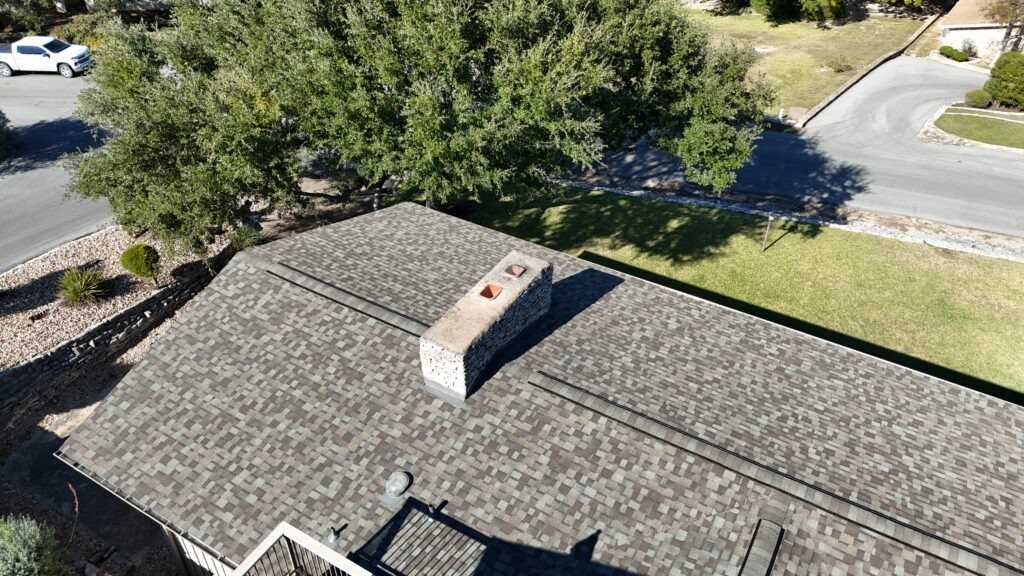
Architectural shingles, also known as dimensional or laminated shingles, are a high-quality grade of asphalt roofing. Unlike traditional shingles, which are made from a single layer, architectural shingles are constructed from two or more layers of asphalt that are laminated together.
The Anatomy of an Architectural Shingle
- Heavy-Duty Fiberglass Base: This provides structural integrity and fire resistance.
- Ceramic-Coated Granules: These provide the color and, more importantly, protect the asphalt from UV degradation—a critical factor under the relentless Austin sun.
- Multiple Layers: The “laminated” nature allows manufacturers to create a three-dimensional look that mimics natural wood shakes or slate.
For Central Texas homeowners, the “architectural” aspect isn’t just about the look; it’s about the mass. Because they are thicker and heavier than standard shingles, they offer significantly better protection against the high winds often associated with hail, wind, and rain along the I-35 corridor.
2. Architectural vs. 3-Tab Comparison
Most homeowners are choosing between the “standard” 3-tab shingle and the architectural upgrade. This choice is often a matter of long-term savings versus short-term cost. In the Hill Country, where wind speeds can escalate quickly during spring storms, the structural differences are profound.
Comparison Table
|
Feature |
3-Tab Shingles |
Architectural Shingles |
|
Appearance |
Flat, uniform, “brick-like” |
Dimensional, textured, slate-like |
|
Wind Rating |
60–70 MPH |
110–130+ MPH |
|
Lifespan (Central TX) |
12–18 years |
25–40 years |
|
Weight |
Lightweight (approx. 240 lbs/sq) |
Heavy (approx. 340+ lbs/sq) |
|
Hail Resistance |
Low |
High (especially Class 4 IR) |
|
Curb Appeal |
Standard |
High (Increases resale value) |
Why Impact Roofing & Renovation Favors Architectural Shingles
For Central Texas, the wind rating is the dealbreaker. A standard 3-tab shingle can be stripped off by a moderate thunderstorm. Architectural shingles are rated for much higher wind speeds, which is a requirement in many “Windstorm” counties and a recommendation for tornado-prone areas as well.
Impact Roofing & Renovation typically recommends UL 2218 Class 4 rated roofing materials. That means that you won’t see quotes as low as some other local roofing companies might provide. We don’t use your peace of mind as a negotiation tool. We believe that in an area prone to “Hail Alley” conditions, providing anything less than Class 4 is doing a disservice to the homeowner.
3. The Gold Standard: Class 4 Impact Resistance
In Central Texas, we don’t just get rain; we get ice. From Cedar Park down to Buda, hail is the leading cause of roof failure. This is why we focus heavily on the UL 2218 Class 4 Impact Rating.
What is Class 4?
To receive a Class 4 rating, a shingle must withstand a test where a 2-inch steel ball is dropped from a height of 20 feet onto the same spot twice. If the shingle does not crack or tear, it earns the rating.
SBS Polymer-Modified Asphalt
Standard architectural shingles are made of “oxidized” asphalt, which can become brittle over time in the Texas heat. The Class 4 shingles we use as our standard are often made with SBS (Styrene-Butadiene-Styrene), a rubberizing polymer.
- Flexibility: The “rubberized” nature allows the shingle to act like a shock absorber when hail hits.
- Granule Retention: It holds onto the protective granules better, which is vital in West Lake Hills and Dripping Springs where UV exposure is high.
- Insurance Discounts: Most major Texas insurance providers offer a significant premium discount (often 15-25%) for homes with a certified Class 4 roof. Over the life of the roof, this can actually pay for the difference in material cost.
4. Installation Considerations for the Hill Country
In Central Texas, the installation method is just as vital as the shingle itself. The heat-cool cycle (thermal shock) here is extreme, and your roof needs to “breathe.”
High-Performance Underlayment
We move beyond the standard felt paper. For our Central Texas clients, we use Synthetic Underlayment. It doesn’t absorb moisture, it won’t rot, and it provides a much more secure walking surface for installers on those steep West Lake Hills slopes.
Ventilation: The Attic “Bake” Factor
An improperly ventilated attic in Dripping Springs can reach 160°F. This heat will “cook” your shingles from the bottom up, causing premature granule loss. We calculate the specific Net Free Ventilating Area (NFVA) for every home to ensure a balanced system of intake (soffit) and exhaust (ridge) vents.
The “Starter” and “Ridge” Shingles
Standard shingles are often used as starters or ridge caps by budget contractors. To maintain the wind warranty (up to 130 MPH), we use specific Starter Strips and High-Profile Ridge Caps designed by the manufacturer to work as a unified system.
The Impact Roofing Difference
At Impact Roofing & Renovation, we don’t treat Class 4 Impact Resistance as an “upgrade” you have to fight for. It is our baseline. We serve the communities we live in—from the I-35 corridor to the heart of the Hill Country—ensuring that every roof we install is built to survive the next Texas “Hundred Year Storm.”